Free stage plot maker for bands
A stage plot is the drawing of your stage seen from the audience: where each musician stands, where the drums, amps and wedges go and where you need power. It goes inside the technical rider, and the venue's crew reads it during load-in to have the stage set before you arrive for soundcheck.
This guide was written by musicians and sound engineers.
What a good stage plot shows
- Audience view. Always. Write «AUDIENCE» at the bottom and mark left and right as seen from the audience, so nobody has to guess.
- Every musician, by name and instrument. «Sam · lead vox» is easier to read at 4 pm than a circle with no name.
- Everything that takes floor space or needs a cable. Drums and riser, amps, keyboards, pedalboards, DJ booth.
- Monitors with their mix number. Wedges or in-ears, with the same numbers as your monitor list.
- Power. Each spot that needs a socket, and how many.
- The same channel numbers as your [input list](/riderize/guides/input-list?lang=en&src=web). If the guitar is channel 10, write a 10 next to the guitar amp. It's the first thing the engineer checks.
- Measurements, if you can. A plot drawn to scale tells you whether the band fits on that stage before the day of the gig.
How a band is usually placed
There's no law, but many of the plots that reach a venue look quite alike:
- Two rows. At the front, whoever faces the audience: vocals, horns, guitars and bass, all at the same depth. At the back, drums and keys, often on a riser.
- Drums in the centre only if they're alone at the back. If they share the back row with the keys, one on each side.
- Mirrored. Two guitars, or bass and guitar, at the same distance from the centre. The stage stays balanced, and so do the wedges.
- The amp behind its owner and the pedalboard in front. That way no cable crosses the stage and the pedalboard's socket is asked for where it's needed.
- Exceptions on purpose. A singer-songwriter with an accompanist puts both at the front. In a band with horns, bass and guitar often sit in a middle row, between the drums and the horns.
Example: rock trio in a small venue (6 × 4 m)
Drums, bass and guitar with lead vocal. As the drums are alone at the back, they go in the centre. 3 monitor mixes, 4 power points and the lead vocal where everyone can see it.
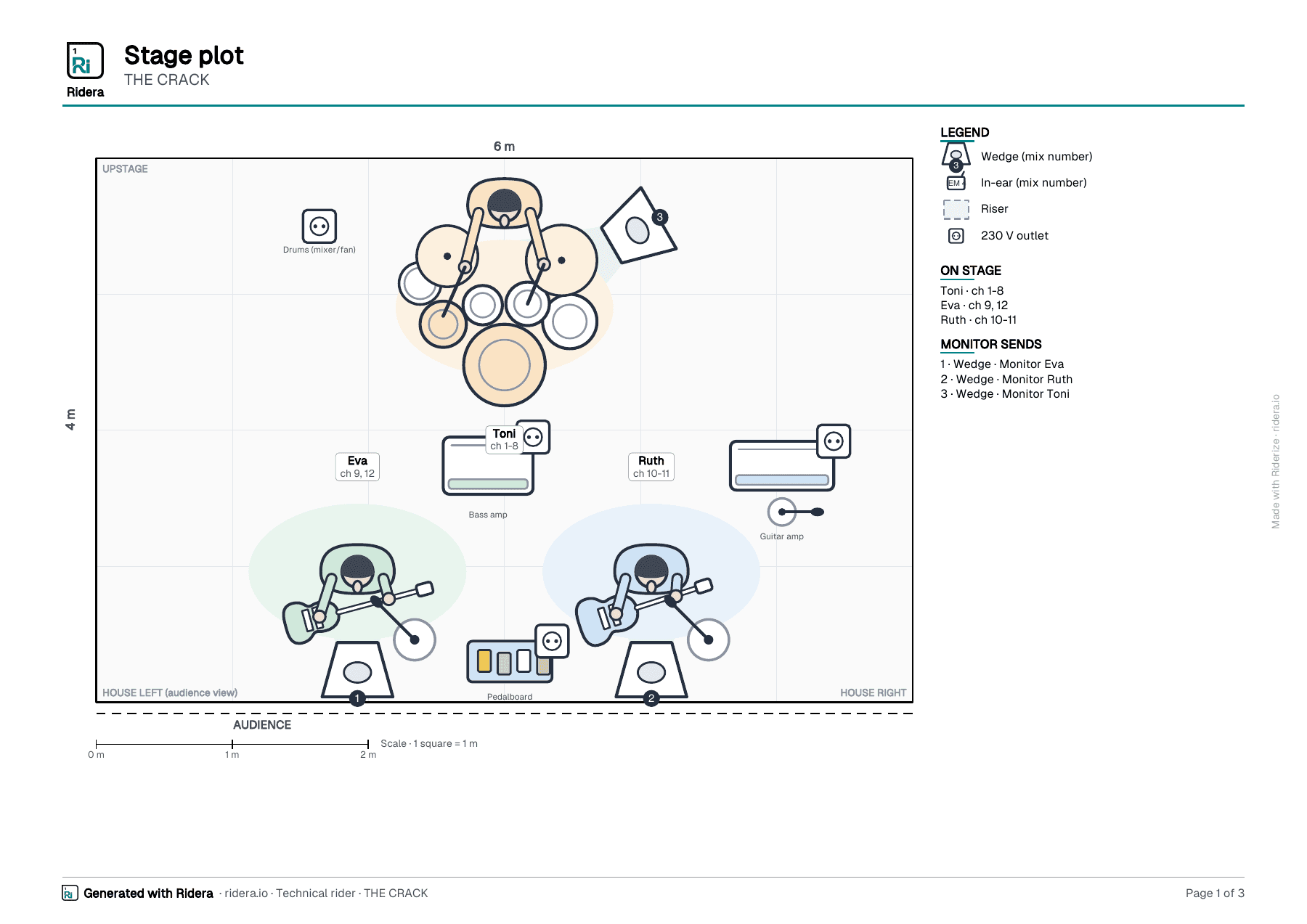
Reference stage sizes
If you don't know what stage you'll find, draw the plot for the place you play most. These are the sizes Riderize starts from, with an indicative clear height (from the floor to whatever is above):
Stage sizes
| Type of place | Width × depth | Clear height |
|---|---|---|
| Bar / acoustic | 4 × 3 m | 2.5 m |
| Small venue | 6 × 4 m | 3 m |
| Mid-size venue | 8 × 6 m | 4.5 m |
| Theatre / large venue | 10 × 8 m | 6 m |
| Town festival / marquee | 12 × 8 m | 8 m |
| Festival | 14 × 10 m | 10 m |
| Large festival | 18 × 12 m | 12 m |
They're indicative: every place is different and the venue adjusts the plot if needed. But a plot drawn for 8 × 6 when you play bars makes life harder for everyone.
Mistakes we see often
- A phone photo of a napkin. It gets forwarded three times and nobody can read it.
- Drawn from the band's point of view. Stage left and stage right swap and the bass amp ends up on the wrong side.
- A festival plot for a bar. A festival crew can adapt a small plot; a bar can't fit a big one.
- Plot and input list that don't match. One says two guitars, the other says one.
Make yours free with Riderize
Riderize is a free stage plot maker, built into a technical rider maker:
- Tell it your line-up, or pick a similar template. It already knows the channels, mics and monitors that go with it.
- Pick the stage size from the table above, or enter yours in metres. The plot is drawn to scale, on a one-metre grid.
- It places the band with the rules above (two rows, mirrored, amps behind) and you drag everyone where you want. You can add wedges, in-ears, sockets, power strips and risers, and rotate what you need.
- Share it with a link, together with the rest of the rider, and print it or save it as a PDF.
Power is asked for in the zone where each musician stands on the plot, so the plot and the rider never contradict each other. It's free, no card; at the end it asks for an email to save it.
Stage plot template or stage plot maker?
A stage plot template (a Word file or an image you edit) works if you're handy with drawing tools and your line-up never changes. A maker like Riderize starts from your line-up, keeps the plot and the input list in step and gives you one link to send to every venue. To see a plot inside a complete rider, here's a technical rider example.