Technical rider example and free template
A technical rider (or tech rider) is the document you send to the venue before the gig so the sound engineer knows what you need on stage. Below is a complete example for a four-piece band, then a free template to make yours, then what each part is for.
This guide was written by musicians and sound engineers.
The example: a four-piece rock band
NORTHBOUND · Technical rider · v3, October 2026
Technical contact: Alex, +00 000 000 000, alex@example.com
Input list
| Ch | Instrument | Mic or DI | Stand | Phantom |
|---|---|---|---|---|
| 1 | Kick | Beta 52 or similar | Short boom | No |
| 2 | Snare top | SM57 | Short boom | No |
| 3 | Snare bottom | SM57 or similar | Clip | No |
| 4 | Hi-hat | Condenser | Short boom | Yes |
| 5 | Tom | e604 or clip-on | Clip | No |
| 6 | Floor tom | e604 or clip-on | Clip | No |
| 7 | Overhead L | Condenser | Tall boom | Yes |
| 8 | Overhead R | Condenser | Tall boom | Yes |
| 9 | Bass | DI (we bring it) | Yes | |
| 10 | Guitar | SM57 | Short boom | No |
| 11 | Vox Sam (lead) | SM58, can't be swapped | Tall boom | No |
| 12 | Vox Alex (backing, bass) | Any dynamic vocal mic | Tall boom | No |
| 13 | Vox Jo (backing, guitar) | Any dynamic vocal mic | Tall boom | No |
Monitors (4 mixes)
| Mix | Who | Wedge or in-ear | What they want |
|---|---|---|---|
| 1 | Alex, bass, stage left | Wedge | Kick, own vocal |
| 2 | Sam, lead vocal, centre | Wedge | Own vocal, a bit of guitar |
| 3 | Jo, guitar, stage right | Wedge | Lead vocal, bass |
| 4 | Drummer, back centre | Wedge, beside the kit | Bass, lead vocal |
Stage plot (seen from the audience): drums back centre on a riser if you have one; bass amp stage left, guitar amp stage right; three vocal mics across the front. Power: one socket at the drums (for a fan or a small mixer), one at the bass amp, one at the guitar amp, one at the pedalboard (front right).
Backline
- We bring: guitar amp, bass amp, snare, cymbals, pedals, bass DI.
- We ask for: drum kit (kick 22", rack tom, floor tom, hi-hat stand, 2 cymbal stands, throne). Happy to share with other bands on the bill.
That's the whole rider: one page and a stage plot. Short and specific gets you a better soundcheck than long and copied.
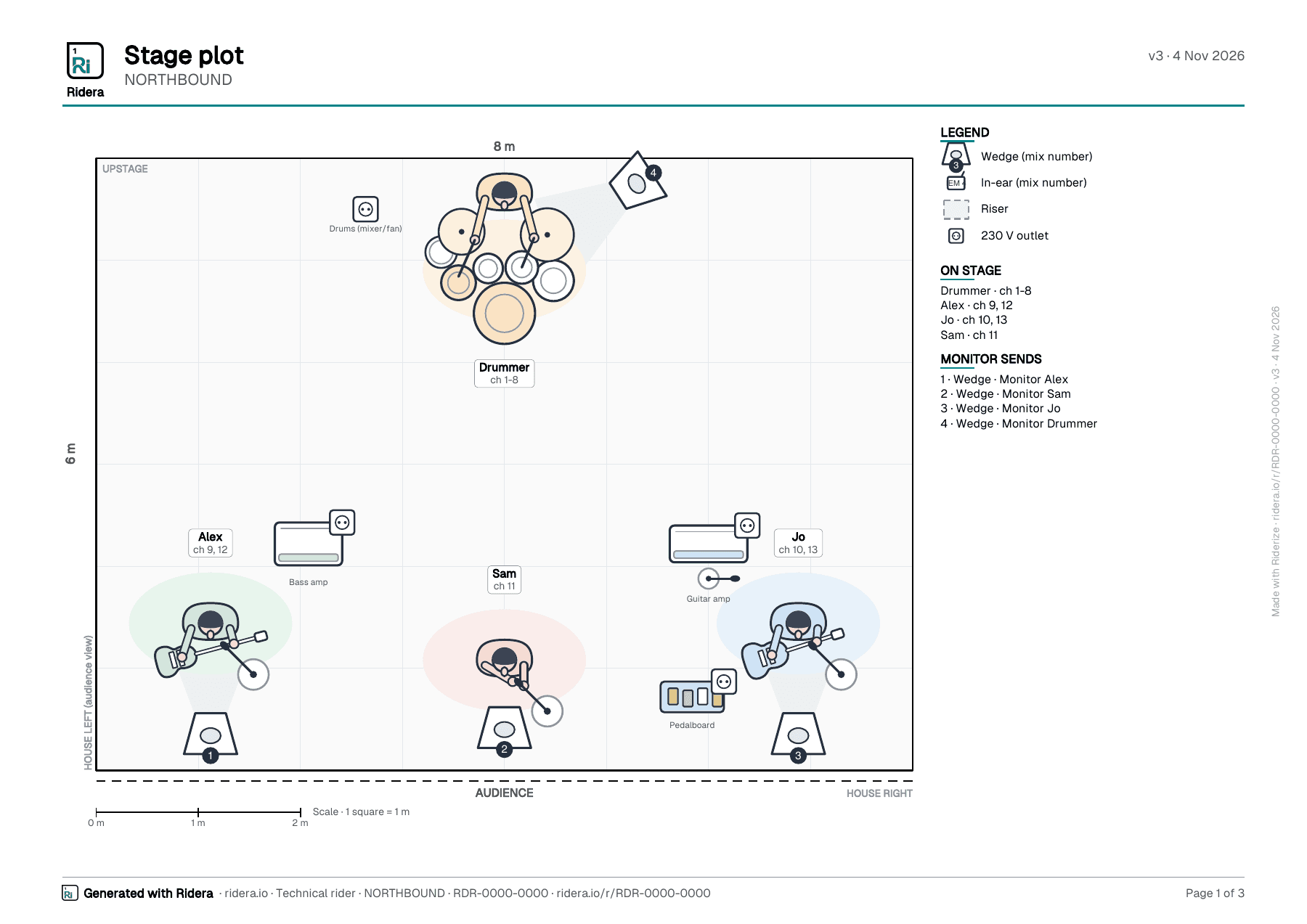
Free template: make yours with Riderize
Riderize is a free tech rider template that fills itself in. Tell it your line-up and it prepares the input list, monitor mixes and stage plot in the same order as the example above. You adjust what's different and export one PDF for the venue.
Free, no card.
What each part is for
Input list.The first thing the engineer reads: they count channels and check they fit the desk. Number in the usual order (drums from the bottom up, bass, guitars, keys, vocals last). Write "or similar" when any mic will do, and say "can't be swapped" only for the one that really matters. Name the singers: "Vox Sam" is easier than "Vox 1" in the middle of a song.
Monitors. One line per mix: who, where, wedge or in-ear (and whether you bring your own in-ear pack) and what they want to hear in a few words. If two people share a mix, say so.
Stage plot. Where everyone stands, seen from the audience, with amps, wedges and power points. It has to match the input list: if the guitar is channel 9, put a 9 next to the guitar.
Backline. Keep what you bring apart from what you ask for. If you can share a kit or an amp with other bands, say so.
Technical contact. Someone in the band who knows which DI you use.
Not in the tech rider: food, drinks and dressing room go in the hospitality rider, a separate document.
Mistakes we see often
- Copying a bigger band's rider. Forty-eight channels for a bar with a sixteen-channel desk makes the venue doubt the rest.
- No date or version.If the line-up changes and the venue has the old one, on the day there's one mic too many and one missing.
- Input list and stage plot don't match.It's the first thing that gets checked.
- A photo or five files. One PDF, with the band name in the file name.