Tech rider templates by line-up, free
Riderize starts your technical rider from your line-up: it already knows the channels, mics, monitors and stage plot that go with it. These are its 13 line-ups, with what each one starts with. Pick the closest, change what's different and send one PDF to the venue.
If this is your first rider, read the technical rider example and free template first.
This guide was written by musicians and sound engineers.
Every line-up
| Line-up | Who | Channels | Monitor mixes | Stage |
|---|---|---|---|---|
| Rock trio | Drums, bass and guitar — the classic | 12 | 3 | 6 × 4 m |
| Covers band (5) | Drums, bass, guitar, keys and vocals | 15 | 5 | 8 × 6 m |
| Singer-songwriter / acoustic duo | Acoustic guitar and vocals (+ optional partner) | 4 | 2 | 4 × 3 m |
| DJ + vocals | DJ booth with a vocalist | 3 | 2 | 6 × 4 m |
| Urban / hip-hop | DJ or tracks with one or two MCs up front | 4 | 3 | 8 × 6 m |
| Band with horns (7) | Full rhythm section + horn section | 20 | 7 | 10 × 8 m |
| Rock / indie (4) | Drums, bass and two guitars — one sings | 13 | 4 | 8 × 6 m |
| Pop with backing vocals (6) | Full band with a backing vocalist | 14 | 6 | 8 × 6 m |
| Rumba / acoustic fusion | Acoustics, cajón and vocals — the small-venue circuit | 9 | 4 | 6 × 4 m |
| Orchestra / village fiesta (10) | Rhythm, horns and three voices — town festival | 22 | 10 | 12 × 8 m |
| Jazz trio | Stage piano, double bass and a small kit | 7 | 3 | 6 × 4 m |
| Church / worship band | Drums, bass, electric, keys, acoustic with lead vocal and two backing singers | 17 | 7 | 8 × 5 m |
| Solo artist with backing tracks | Vocals and guitar with backing tracks and click to monitors | 5 | 1 | 4 × 3 m |
Channels and mixes are for a band with no engineer of its own; the stage is the usual one for that line-up. You can change all of it. Examples with every channel: the four-piece rock band and the rock trio.
Example: acoustic duo
A singer on acoustic guitar and an accompanist on cajón who sings backing vocals. 4 channels, 2 monitor mixes and a stage plot for a small stage (4 × 3 m).
Input list (4 channels)
| Ch | Source | Mic or DI | Stand | Phantom |
|---|---|---|---|---|
| 1 | Cajón | Shure Beta 91A or similar | Short stand | No |
| 2 | Acoustic guitar | DI from the guitar preamp | — | Yes |
| 3 | Lead Vocal (Marta) | Shure SM58 or similar | Tall boom stand | No |
| 4 | Backing Vocal (Pablo) | Shure SM58 or similar | Tall boom stand | No |
Monitors (2 mixes)
| Mix | Who | Wedge or in-ear |
|---|---|---|
| 1 | Marta | Wedge |
| 2 | Pablo | Wedge |
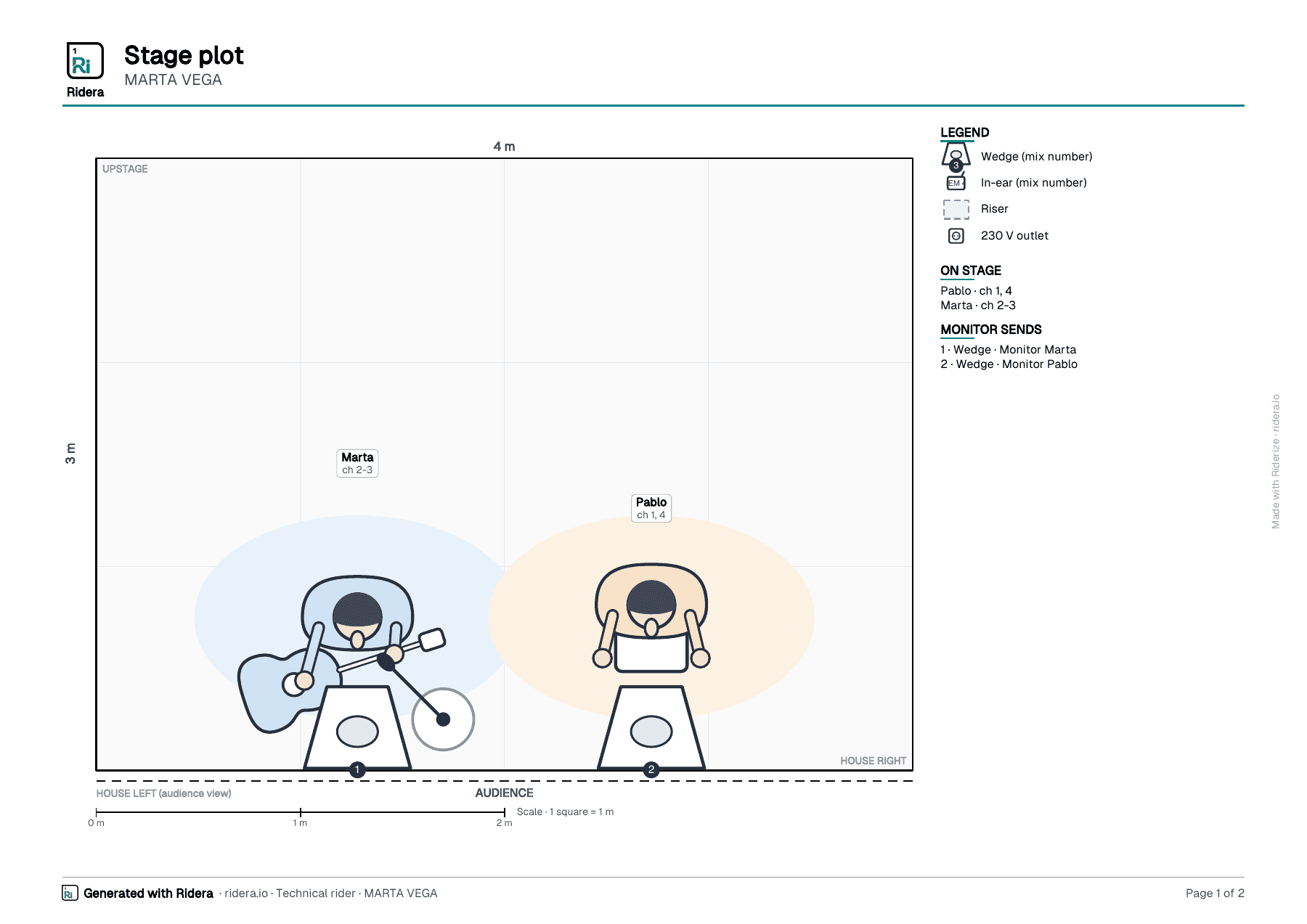
Power: with no amps on stage, the plot asks for no sockets. If you use a looper, a pedal or an in-ear pack, add a socket in the stage plot step and it goes on the rider too.
Three things to change for your duo
- Solo, no accompanist? Remove the cajón and the backing vocal: you're down to 2 channels and one monitor mix.
- Guitar with no pickup? Say so: the venue will put a small condenser on it instead of the DI, and that needs phantom.
- Loops or backing tracks? Add the channels (stereo takes two) and say the click goes only to your monitor. More on that in the input list guide.
Make yours, free
In Riderize, pick your line-up («Singer-songwriter / acoustic duo» for this duo) and it numbers the channels, suggests the mics with equivalents, works out the monitors and draws the stage plot to scale. Change what's different and export one PDF for the venue. Free, no card; at the end it asks for an email to save it.